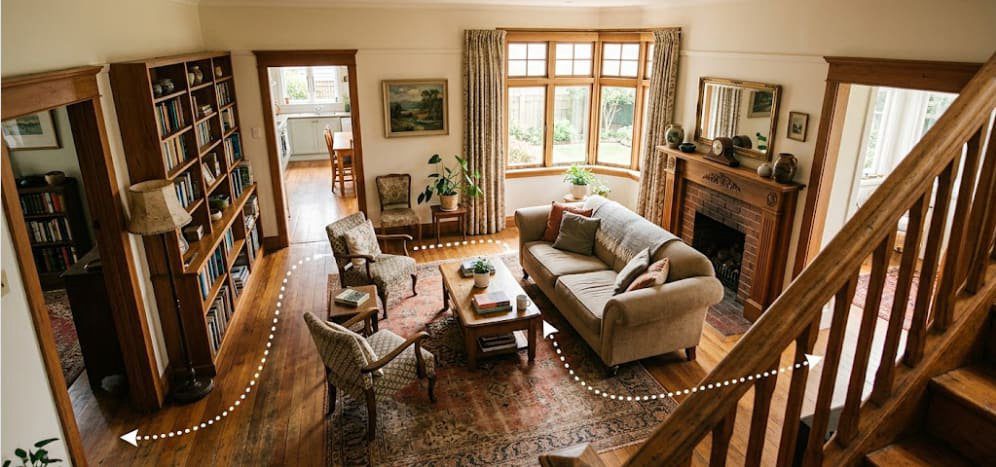
The Room That Feels Wrong — But You Can't Say Why
Years ago, a friend invited me over to see her newly decorated living room. She'd chosen beautiful furniture. The colors were lovely. The rug was the right size. But something felt off, and she couldn't name it. She kept apologizing: "I don't know why this room makes me tense."
I stood in the doorway and watched her walk through the space. Within ten seconds, I saw the problem. To reach her favorite armchair, she had to edge sideways past the sofa, navigate around a side table, and step over the corner of the rug. She'd been doing it unconsciously every day for months.
That's traffic flow. And once you learn to see it, you'll never arrange a room the same way again.
What Traffic Flow Actually Means
In design school, traffic flow refers to the paths people naturally take through a room — how they enter, how they move between furniture, and how they exit. It's not about foot traffic in the hallway sense. It's about the unspoken choreography of daily life: carrying a coffee mug to the sofa, walking from the front door to the dining table, crossing the room to open a window.
Good traffic flow is invisible. You don't notice it because it simply works — no squeezing, no detouring, no apologizing to your coffee table. Bad traffic flow announces itself constantly, in small frustrations you might attribute to something else entirely.
Good Traffic Flow | Bad Traffic Flow |
|---|---|
A clear path from every doorway to the main seating | Entering guests must walk through a conversation zone |
At least 30 inches of walking space between furniture pieces | Side tables, ottomans, and chair legs block natural paths |
The room can be crossed without stepping over cords or rug edges | Lamps and electronics are plugged in where people need to walk |
Someone seated doesn't have to move to let another person pass | Every trip to the kitchen requires a choreographed shuffle |
The Mistake Most People Make
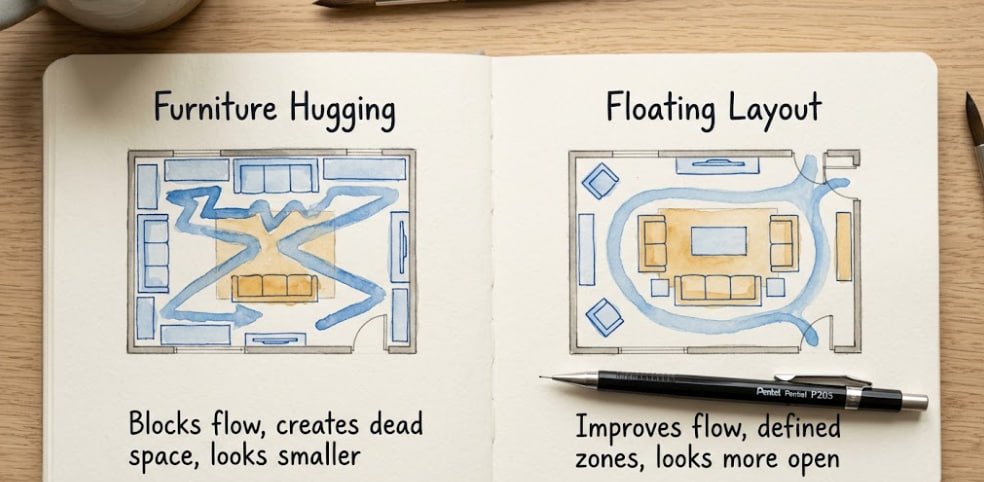
The single most common traffic flow mistake I see — and I saw it in dozens of homes during my design years — is what I call "furniture hugging." People push every piece against the walls, thinking it maximizes space. It doesn't. It creates a dead zone in the center of the room that nobody uses and forces everyone to walk around the perimeter, which is exactly where the doorways are.
Pulling furniture away from the walls — even just eight inches — gives traffic paths room to exist between pieces. A sofa doesn't need to kiss the wall. A reading chair can float in a corner. The room almost always feels larger when furniture has breathing room, not smaller.
How I Sketch Traffic Flow (And You Can Too)
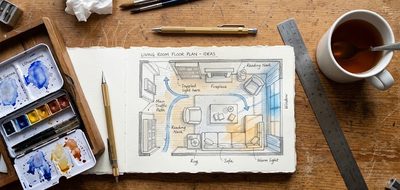
This is the method I use in my watercolor notebook before moving a single piece of furniture. It takes fifteen minutes and has saved me from countless layout regrets.
First, I draw the empty room with all doorways, windows, and fixed elements marked. Then I place a tracing paper overlay — or in my case, I work directly in watercolor washes — and draw a blue line from every doorway into the room. These are the entry paths. Where do people naturally step first? Where do they pause? Where do they go next?
Then I add the main seating area in light pencil. I trace the walking path again with the blue wash. If the line cuts through the seating zone, the layout doesn't work. If the line has to zigzag around obstacles, the layout doesn't work. If the line flows smoothly around the furniture like water around stones in a stream, I've got it right.
Our Own Living Room Lesson
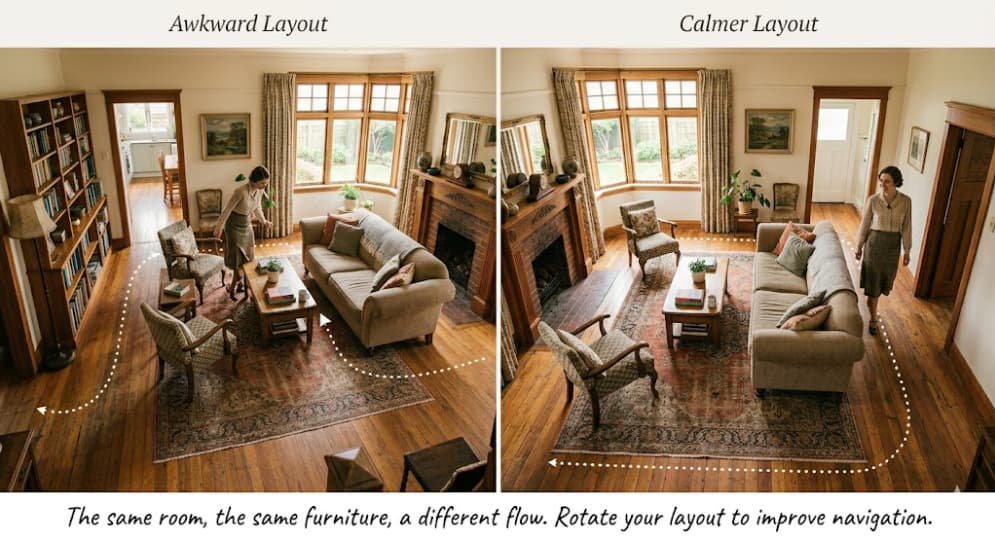
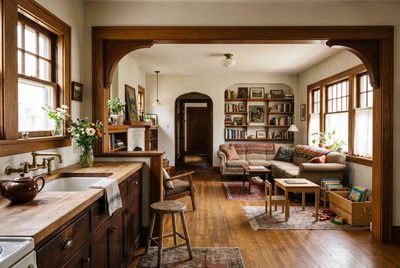
When I applied this to our bungalow living room, the sketch immediately exposed a problem I'd been ignoring. The natural path from the front door to the kitchen cut directly through where I'd planned a conversation area. Anyone entering the house would walk straight between two people trying to talk.
The fix was simpler than I expected. I rotated the sofa ninety degrees, facing the windows instead of the fireplace. The entry path now traces along the back of the sofa, not through the seating. The room feels calmer immediately — not because we bought anything, but because we stopped fighting the way bodies naturally want to move through the space.
Try This in Your Own Room Tonight
Stand in the doorway of your living room. Don't look at the furniture. Look at where your feet want to go. Walk that path naturally, without editing yourself. If you have to step around something, duck under a light fixture, or squeeze between two chairs, you've found your traffic flow problem.
Now sketch it. Or take a photo from above and draw the path with your finger. Move the obstacle — even temporarily — and walk it again. The difference is immediate and almost always free.
A room that flows well doesn't need to be professionally designed. It just needs to let people move through it without thinking. When the thinking disappears, the relaxation can finally begin.
Take your time — your house will still be here tomorrow.
No notes yet — write the first one.