The Countertop Question Every Renovator Asks
In my eight years designing kitchens for clients, I probably had the countertop conversation two hundred times. It was always the same starting point: "What's the most beautiful option?" followed closely by "What's the most durable?" followed by a long pause when I explained that those two answers are rarely the same material.
When it came time to choose counters for our own bungalow kitchen, I had an advantage most homeowners don't. I'd already lived with all three major contenders in previous apartments, client projects, and our earlier rental. I knew exactly what each material does when a toddler dumps applesauce on it and you don't notice for an hour.
Here's what I learned — not from a showroom, but from real life.
The Three Countertops I've Actually Lived With
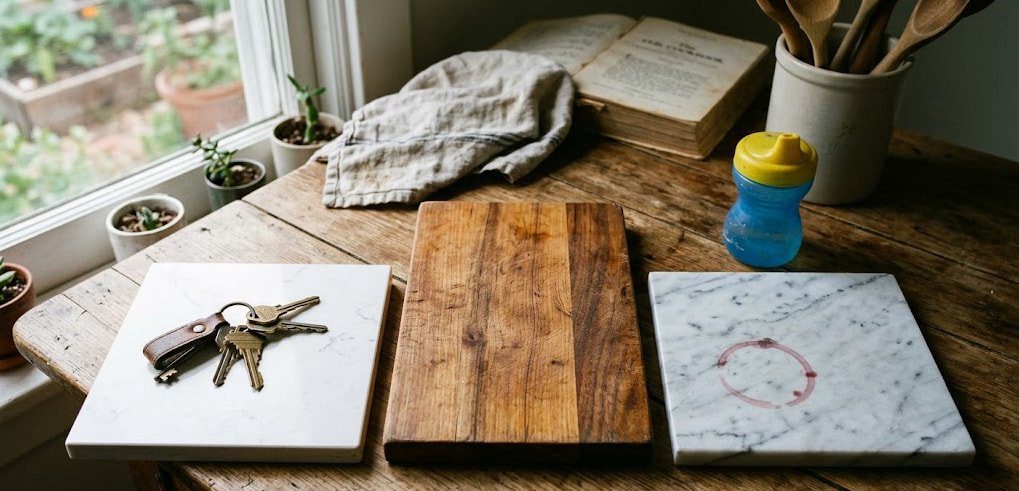
Material | What I Loved | What I Didn't | Real Cost (Per Sq Ft) | The Kid Test |
|---|---|---|---|---|
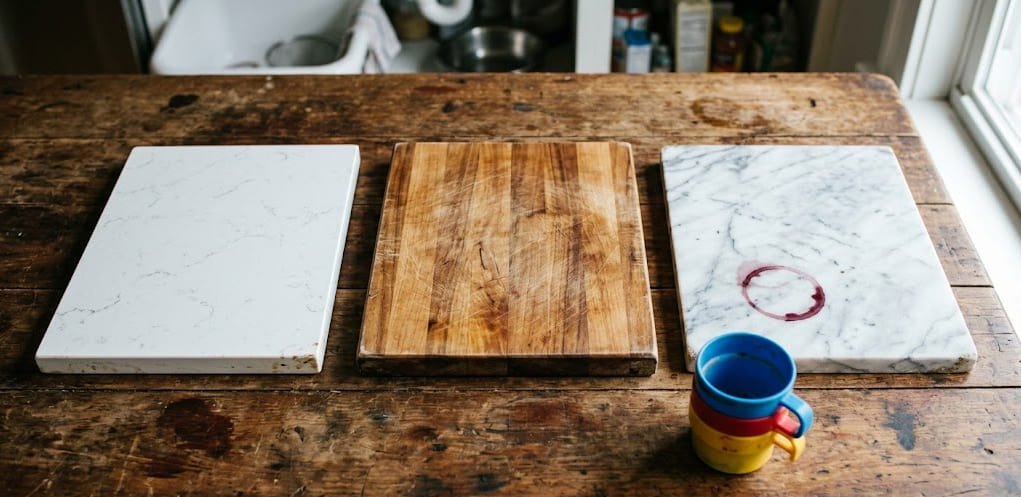
Quartz (Caesarstone) | Zero maintenance, no sealing, wine and coffee wipe right off | Can look too uniform up close, edges chip if you drop a cast-iron pan just right | $65–85 installed | Passed with honors |
Butcher Block (IKEA) | Warm, forgiving, cheap to replace, knives don't dull | Water damage around the sink if you skip sealing, develops a patina that's not for everyone | $30–50 installed | Passed, with maintenance |
Honed Marble | Gorgeous, cool for baking, every stain tells a story | Etches from lemon juice in seconds, red wine leaves permanent marks, constant anxiety | $80–120 installed | Failed completely |
Quartz: What We Chose — and Why
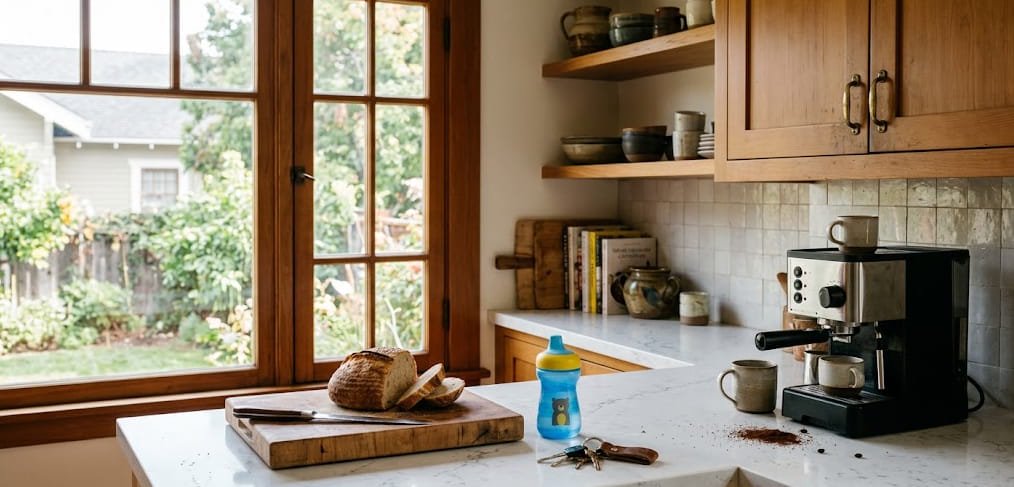
We installed white quartz with a soft grey vein — Caesarstone's "Fresh Concrete" finish — on every counter in our kitchen two years ago. It has not required a single moment of maintenance since installation day. No sealing, no special cleaners, no panicking when Leo drags a toy car across it or Emma drips grape juice.
Derek, who does most of the cooking, was the one who pushed for quartz. He said, "I don't want to think about the counter while I'm cooking. I want it to disappear." That's exactly what quartz does. It performs without demanding attention.
The trade-off is aesthetic. Quartz doesn't have the depth of natural stone. Up close, the pattern repeats in ways marble never would. If you're someone who runs a hand across a surface and feels a spiritual connection to natural material, quartz may leave you a little cold. I've made peace with that.
Butcher Block: The Budget Hero
Our previous rental had butcher block counters from IKEA, and I genuinely loved them. They're warm under your hands, quiet when you set a plate down, and shockingly affordable. When a section near the sink got water-damaged after I neglected to reseal it for two years, I didn't feel guilty. At that price point, replacement didn't require a second mortgage.
The maintenance is real, though. You must oil them every few months. You must wipe up standing water promptly. You must accept that knives will leave marks and that those marks become part of the surface's story. For a family kitchen where beauty is measured in warmth rather than flawlessness, butcher block is a lovely choice.
Marble: I Wish I Could Recommend It
I want to love marble. Every design-trained bone in my body responds to its veining, its cool temperature, its historical weight. I specified it for a client's baking kitchen once, and it was magnificent.
But in a family kitchen with small children, marble is an exercise in constant vigilance. I know because I tried it. A single drop of lemon juice left a dull etch that caught the light for years. A spilled glass of red wine during a dinner party left a ghost I could never fully remove. I spent more time worrying about the counter than enjoying the room.
If you bake seriously and your children are older or nonexistent, marble might be your counter. For the rest of us, let it go.
What I'd Tell a Friend Standing in a Showroom
If you're choosing today and you have young kids, get quartz. Choose a color with enough movement to hide crumbs and fingerprints — solid white shows every speck of coffee grounds. If your budget is tight and you don't mind a little patina, butcher block will serve you well. If you're renovating a forever home where the kids are already teenagers, then — and only then — consider marble.
The Counter Is Not the Point
Here's what I've realized after two years with our quartz counters: I almost never think about them. They don't stain, they don't scratch, they don't haunt me. That's the highest compliment I can give any surface in a family kitchen. A counter that lets you forget about it frees you to pay attention to what's actually happening in the room — cooking together, cleaning up together, living together.
Take your time — your house will still be here tomorrow.
No notes yet — write the first one.