The Question Every Client Used to Ask
In my eight years as a residential designer in Los Angeles, I can count on one hand the number of clients who didn't begin their kitchen renovation conversation with some version of "We want to open it up." The open concept floor plan has become the default ambition, the gold standard, the thing you're supposed to want. If your walls aren't coming down, the thinking goes, are you even renovating?
I understand the appeal. I really do. An open plan can feel expansive, social, and filled with light. When I was a junior designer, I drew dozens of them, swept up in the same enthusiasm. But after years of watching families actually live in these spaces — including our own family in our 1920s bungalow — I've developed a quieter, more cautious opinion.
Open concept isn't for everyone. And that's perfectly fine.
What the Home Renovation Shows Don't Show You
The television version of an open plan is pristine. Someone cooks while chatting with guests, children do homework at an island that never accumulates mail, and somehow no one ever drops a pot lid that echoes through the entire downstairs.
Real life in an open concept home includes:
The blender drowning out your spouse's phone call
Dinner mess visible from the front door
A toddler's tantrum broadcasting into every shared space
No room to hide a single pile of laundry, ever
I learned this firsthand when we looked at several fully open-plan houses during our house hunt. They photographed beautifully. But standing in one with a two-year-old Emma, I watched Derek try to have a quiet conversation with our realtor while Emma sang at full volume in the next "zone." There was no wall. There was no break. There was no peace.
A Quick Comparison: Open vs. Not-Open
What Matters | Fully Open Plan | Defined Rooms |
|---|---|---|
Natural light | Flows across the entire space | Can be directed to specific rooms with windows |
Noise control | None — sound carries everywhere | Walls absorb and contain sound |
Visual calm | Requires constant tidying across all zones | Mess can be contained in one room |
Entertaining | Cook can talk to guests | Guests can gather while kitchen mess stays hidden |
Family with young kids | Children are always in view, but also always in earshot | Supervision still possible with sightlines through openings |
Heating and cooling | Inefficient in older homes | Easier to zone by room |
Resale appeal | High in many markets | High for buyers who want privacy |
The 1920s Bungalow Answer
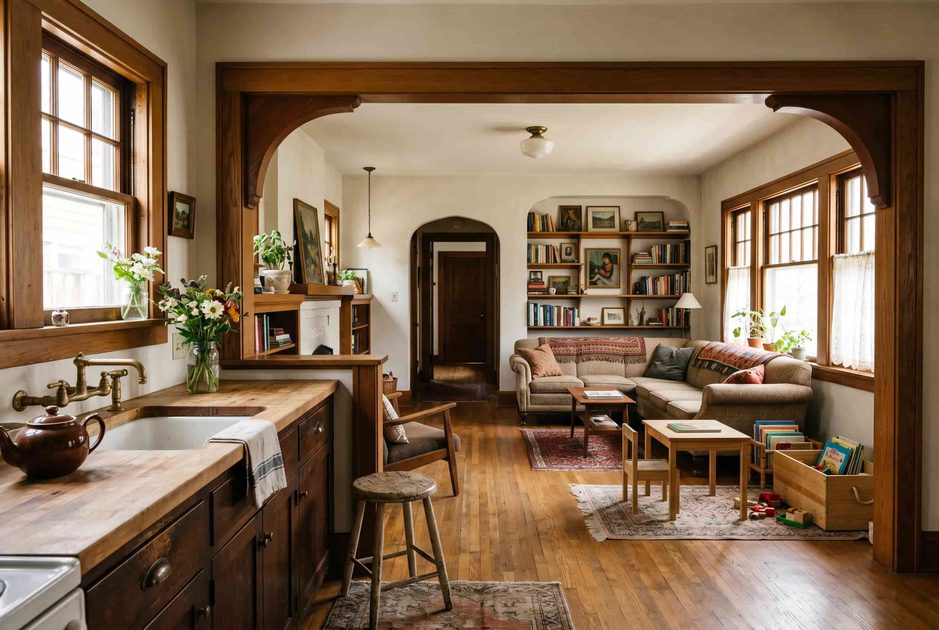
Our house was built in an era when rooms had doors. The kitchen was a separate room. The living room had walls. The dining room was its own space with a swinging door to the kitchen. When we bought the bungalow, many people asked if we planned to knock down all the walls and "open it up."
We didn't. Here's why.
The existing layout had a rhythm I didn't want to destroy. The separation between kitchen and living room meant that when Derek cooked dinner — he's the family chef — I could sit in the living room with Emma and Leo without the sound of sizzling onions overpowering their bedtime story. The dining room, tucked between them with a wide cased opening rather than a wall, created just enough connection without losing the sense of occasion that a dedicated dining space provides.
I did widen one opening between the kitchen and dining room. Not to create an open concept, but to improve sightlines so I could see the kids playing in the living room while I prepped dinner. That's the nuance most of the "tear everything down" advice misses: you can improve connection without eliminating all boundaries.
The Alternative Most Families Overlook: "Broken Plan"
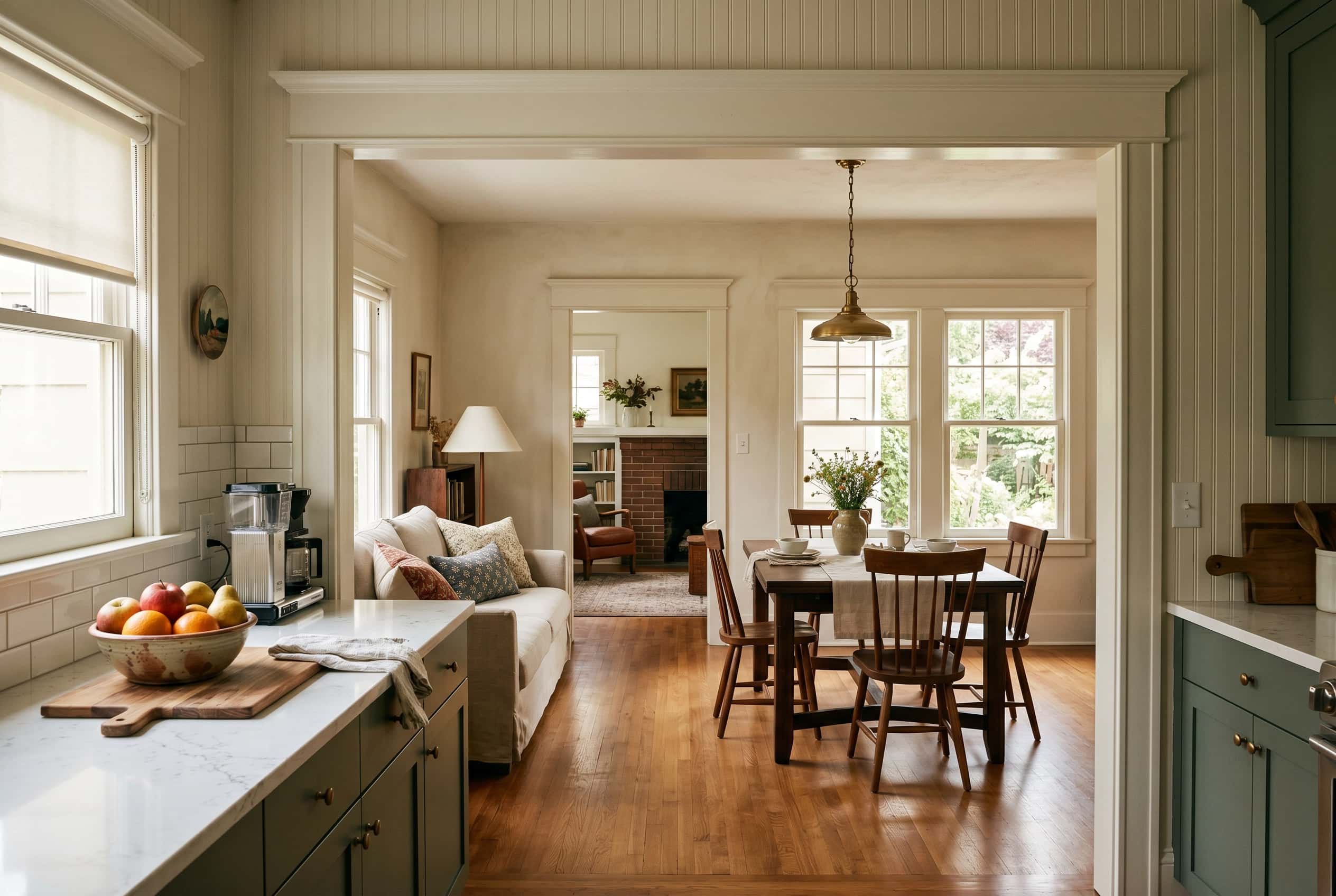
There's a middle ground that I wish got more attention. It's sometimes called a "broken plan" layout, and it's essentially what our bungalow already had in its bones. Instead of removing every interior wall, you keep or create partial separations — wide cased openings, interior windows, half-walls, or glass-paned doors that let light and sightlines through while still defining distinct zones.
Here's why this works particularly well for families with young children:
You can still see and hear kids, but you can also close a door when you need quiet
Mess stays contained without isolating the cook from the rest of the household
Each room can have its own mood — a cozy den, a bright kitchen, a calm dining room
You're not heating or cooling one enormous space in a drafty old house
How to Decide What's Right for Your House
If you're standing in your own home right now wondering whether to take a sledgehammer to a wall, I'd ask you three questions:
How do you actually live, day to day? Not how you entertain on holidays. Not how you wish you lived. On a Tuesday evening with cranky kids and a sink full of dishes, would an open plan feel expansive or exposing?
What's the noise reality of your household? If one person cooks while another watches TV while children play, walls are not your enemy. They're your allies.
What does the house want? This sounds philosophical, but some houses were designed with distinct rooms for a reason. Our 1920s bungalow has a structural rhythm that would fight a fully open plan. Respecting that rhythm cost less and looks more authentic than forcing it into something it was never meant to be.
No One Will Revoke Your Design Credentials
I've had friends confess in hushed tones that they actually prefer rooms with walls. As if admitting that out loud means they've failed some modern design test. Let me say this clearly: preferring defined spaces is not a design failure. It's a preference, grounded in how you actually live.
The right layout is the one that makes your daily life easier, not the one that photographs best for Instagram. For our family, that meant keeping most of our walls. For yours, it might mean taking every single one down. The point isn't which approach you choose — it's that you choose it thoughtfully, not because a renovation show made you feel like you had to.
Take your time — your house will still be here tomorrow.
No notes yet — write the first one.